Okay, let me ask you something. What’s the fastest thing you can think of right now? A sports car? A fighter jet? A really impatient person at a buffet line?
None of them have anything on the peregrine falcon. This bird — this bird — hits speeds of over 240 miles per hour during a dive. That’s faster than a Formula 1 car at full throttle. Faster than most military aircraft in level flight. Faster than literally anything else that’s alive on this planet.
And that’s just the beginning. Honestly, the speed records held by birds are so outrageous that if you told someone who’d never heard of them, they’d think you were making it up. So let’s dive in — pun absolutely intended — into the world of the fastest birds on Earth.
The Official Speed Rankings: Top 10 Fastest Birds
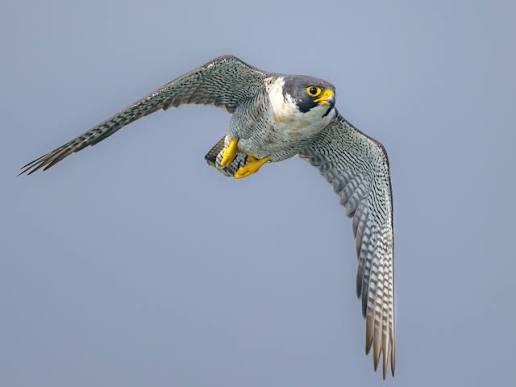
The Peregrine Falcon: The Fastest Animal Alive
Let’s talk about the peregrine falcon properly, because this bird deserves more than just a number on a chart. The peregrine is found on every continent except Antarctica. It’s one of the most widespread birds of prey on Earth. And it is, without question, the fastest animal that has ever lived.
The stoop — that’s the technical term for its hunting dive — is a masterpiece of evolutionary engineering. The peregrine climbs to altitude, spots its prey from up to 3 miles away (yes, really), and then folds its wings tight against its body and drops. In that configuration, it’s essentially a feathered missile.
How Does It Survive Going 240 mph?
This is the question I couldn’t stop thinking about the first time I really understood what 240 mph meant for a living creature. At that speed, the aerodynamic forces on the falcon’s body are immense. The air pressure alone could collapse its lungs. So how does it not just… explode?
A few remarkable adaptations make it possible. First, the peregrine has small bony tubercles inside its nostrils — little cone-shaped structures that deflect incoming air and prevent its lungs from being overwhelmed by the pressure. It’s essentially the same technology used in jet engine intake design. A bird figured it out millions of years before we did.
Second, its nictitating membrane — a transparent third eyelid — protects its eyes while still allowing it to see. At 240 mph, exposed eyeballs would be a serious problem. The membrane solves it.
Third, and perhaps most impressive, the peregrine’s heart beats up to 600 times per minute during a stoop. Its cardiovascular system is built for exactly this kind of extreme, brief exertion. It burns hot and fast, then recovers.
SPEED SCIENCE
A peregrine falcon in a full stoop generates aerodynamic forces exceeding 25 times the force of gravity — or 25G. Fighter pilots regularly black out at 9G. The peregrine handles nearly three times that load, fully conscious, navigating a moving target.

Its hollow bones, rigid spine, and specialized cardiovascular system make it the most extreme speed machine evolution has ever produced
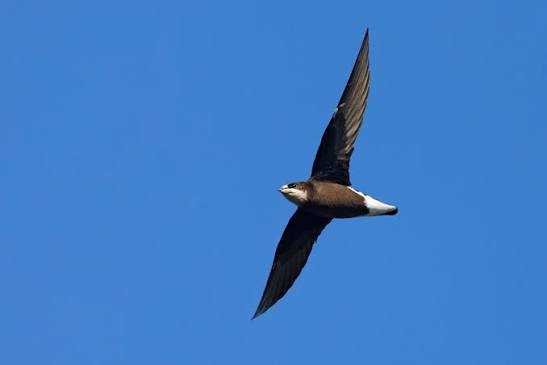
Fastest Bird in Level Flight: The White-throated Needletail
Now here’s where people get confused. The peregrine falcon hits 240 mph — but only in a dive. When it comes to level flight, the crown belongs to someone else entirely: the white-throated needletail, a large swift found across Asia and Australia.
In straight, unassisted horizontal flight, the needletail reaches 106 mph. That’s faster than any other bird flies horizontally. For context, that’s faster than most cars on a motorway, faster than a galloping racehorse, and faster than you’ll ever go in a taxi no matter how late you are for your flight.
What’s remarkable about the needletail — and swifts generally — is that they are almost entirely aerial creatures. They eat airborne insects. They drink by skimming water surfaces at speed. They sleep on the wing, entering slow-wave sleep while gliding in wide circles at altitude. Some individuals spend over ten months airborne without a single landing. The needletail’s legs are so poorly developed from disuse that landing on a flat surface is genuinely difficult. It needs a vertical surface — a cliff, a tree — to launch itself back into the air.
In other words, it has committed so completely to flight that the ground has become almost inaccessible to it. That’s the kind of evolutionary specialization that’s simultaneously awe-inspiring and slightly alarming.
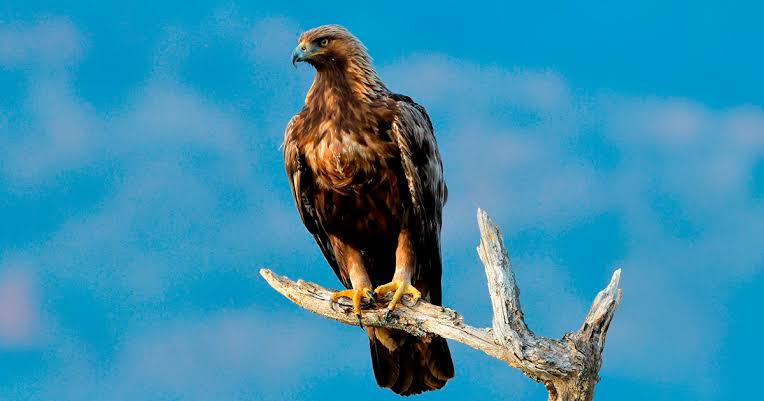
The Golden Eagle: Power Plus Speed
By the way, let’s not sleep on the golden eagle. While the peregrine gets all the speed glory, the golden eagle is arguably the more impressive all-around performer. It dives at up to 150 mph, covers territories of up to 60 square miles, and regularly takes prey as large as young deer and mountain goats.
- Wingspan : Up to 7.5 feet — the golden eagle’s wings are built for sustained soaring as much as speed, allowing it to patrol vast territories without expending excessive energy.
- Grip Strength: Its talons exert over 400 pounds per square inch of pressure — enough to crush bone. At 150 mph with that grip force, the impact with prey is immediately fatal.
- Vission: 8x sharper than human vision. A golden eagle can spot a rabbit from 2 miles away. It sees into the ultraviolet spectrum, making rodent urine trails visible as glowing paths.
- Range : Found across North America, Europe, Asia, and northern Africa — one of the most widely distributed raptors on Earth, adaptable to mountains, deserts, and tundra alike.
The Surprising Speed Records You Didn’t Expect
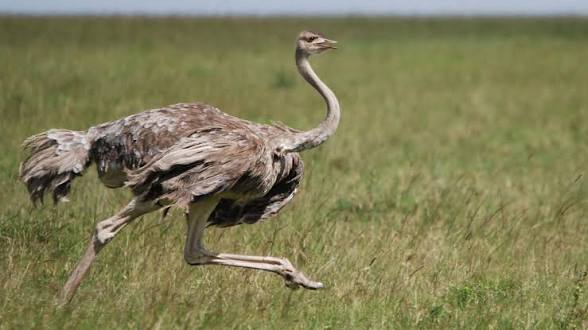
The ostrich can’t fly. We all know that. It’s the big, slightly ridiculous-looking bird that stares at you blankly from behind a fence at the zoo. But get it onto open ground and remove the fence, and suddenly it’s doing 45 miles per hour with 12-foot strides and showing absolutely no signs of slowing down.
For sustained speed — not just a short burst — the ostrich is nearly unmatched in the animal kingdom. It can maintain 30 mph for extended distances. Its stride length covers ground with extraordinary efficiency. And if anything gets close enough to be a threat, it deploys a forward kick with enough force to kill a lion. The ostrich is basically a dinosaur that survived by becoming an endurance athlete with a lethal front kick.
Anna’s Hummingbird: The Relative Speed Champion
Here’s a fact that will genuinely rearrange your brain. Anna’s hummingbird — a tiny, iridescent bird found along the Pacific coast of North America — travels at 385 body lengths per second during its courtship dive.
To put that in human terms: if you were moving at 385 times your own body length per second, you’d be traveling at roughly 1,300 mph. That’s faster than the speed of sound. Proportionally speaking, the hummingbird is the fastest vertebrate on Earth, full stop.
Table of Contents
The Science Behind Bird Speed
So what actually makes a bird fast? It’s not one thing — it’s a whole package of anatomical, physiological, and behavioral adaptations working together. Let’s break it down.
Fast birds share certain wing characteristics. Long, narrow, pointed wings — like those of swifts, falcons, and frigatebirds — reduce drag and allow high-speed flight. Broad, rounded wings like those of owls and hawks are better for slow, maneuverable flight but create too much drag at high speeds.
The peregrine’s wing shape is essentially a natural aerofoil optimized for the stoop. In the folded position during a dive, the wings create minimal frontal area — reducing drag to near nothing — while the tail controls direction with extraordinary precision.
Hollow Bones and Muscle Mass
Bird bones are hollow — but not fragile. They’re reinforced internally with struts, making them both lightweight and structurally strong. Less mass means less energy needed to accelerate and less momentum to control during landing or direction changes.
The pectoral muscles — the flight muscles — account for up to 25% of a fast-flying bird’s total body weight. In the peregrine, these muscles are extraordinarily dense and oxygen-rich. They’re built for explosive power, not endurance — perfect for the burst needed to climb to hunting altitude and then survive the forces of a full stoop.
Expert Insight
Ornithologists at the Max Planck Institute for Ornithology have documented that common swifts sleep while flying, entering periods of slow-wave sleep during nighttime gliding. Their brains have evolved to maintain minimal navigational awareness even during sleep — a level of neurological adaptation that has no parallel in any other vertebrate.
Metabolic Rate: Burning Jet Fuel
Fast birds run hot. Their metabolic rates are extraordinary — the hummingbird’s heart beats up to 1,260 times per minute at peak exertion. The common swift consumes proportionally more oxygen per gram of body weight than almost any other animal on Earth.
This comes at a cost. High-speed birds eat constantly, and their food must be energy-dense. Falcons eat other birds. Swifts eat airborne insects — thousands per day. Hummingbirds drink nectar at extraordinary rates and supplement with insects for protein. Speed isn’t free. It demands fuel.
Speed vs. Agility: Which Matters More?
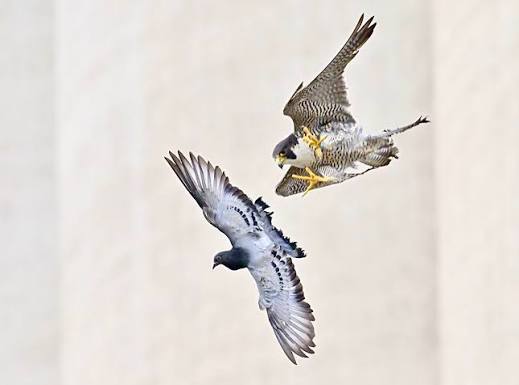
Here’s something I find genuinely fascinating. Pure top speed is almost meaningless in predator-prey dynamics without the agility to use it. A peregrine hitting 240 mph is impressive — but if it can’t adjust its trajectory in the last milliseconds to intercept a dodging pigeon, all that speed is wasted.
The answer is that the fastest birds have co-evolved extraordinary agility alongside their speed. The peregrine makes micro-adjustments using its tail feathers as a control surface, correcting trajectory with movements too fast for human eyes to follow. The eurasian hobby — which can catch swallows and swifts in level flight — relies more on sustained speed and tight turns than brute velocity.
Different hunting strategies demand different combinations of speed and maneuverability. And birds, over millions of years of evolutionary pressure, have tuned these combinations to extraordinary precision.

How Climate Change Is Affecting Fast Birds
It would be dishonest to write about these birds without acknowledging that many of them face real threats. Climate change is disrupting the prey populations that fast birds depend on — particularly the insect communities that swifts and swallows rely on.
Common swift populations across Europe have declined by up to 50% in some regions over the past 25 years. Researchers point to a combination of factors: fewer flying insects due to pesticide use and habitat loss, loss of nesting sites in older buildings due to renovation, and climate-related mismatches in breeding timing.
Peregrine falcons, by contrast, have recovered dramatically since the DDT era, when the pesticide caused eggshell thinning and near-extinction in many regions. Conservation and pesticide bans worked. It’s a genuine success story — proof that when we act decisively, bird populations can and do recover.
Why Speed Matters — And What We Can Learn From It
Here’s the thing about bird speed that I keep coming back to. It wasn’t evolved for our entertainment. Every mph, every adaptation, every structural innovation — it exists because it solved a life-or-death problem. The peregrine needed to catch faster prey. The swift needed to stay airborne longer. The ostrich needed to outrun predators on open ground.
Speed is never the goal. Survival is. Speed is just the mechanism.
And there’s something genuinely humbling about that. We’ve built machines that go faster than any bird — rockets that leave the atmosphere, jets that break the sound barrier. But we built them with centuries of accumulated knowledge, billions of dollars of resources, and the labor of thousands of engineers.
The peregrine falcon built its 240 mph capability with nothing but time and evolutionary pressure. No tools. No drawings. No test flights. Just millions of years of trial and error, death and survival, until something emerged that could fold its wings and become the fastest thing alive.
That, to me, is the most jaw-dropping fact of all.
Frequently Asked Questions
Q: What is the fastest bird in the world?
The peregrine falcon is the fastest bird — and the fastest animal — on Earth, reaching speeds of over 240 mph (386 km/h) during its hunting dive called a stoop. In level flight, the white-throated needletail holds the record at approximately 106 mph (171 km/h).
Q: What is the fastest bird on land?
The ostrich is the fastest running bird, reaching speeds of up to 45 mph (72 km/h) and maintaining 30 mph over long distances. It has the longest stride of any living bird, covering up to 12 feet per step at full speed.
Q: How does the peregrine falcon survive the speed of its dive?
Several adaptations protect the peregrine during its stoop: bony tubercles in the nostrils manage air pressure on the lungs, a nictitating membrane protects the eyes, hollow but strong bones reduce stress fracture risk, and an extraordinarily powerful cardiovascular system handles the G-forces — up to 25G at peak dive speed.
Q: Which bird has the fastest wingbeat?
The horned sungem hummingbird of South America holds the record for fastest wingbeat at approximately 90 beats per second. Most hummingbirds beat their wings 50–80 times per second, creating the distinctive humming sound that gives the family its name.
Q: Can any bird fly faster than a plane?
Not commercial jets, no. But the peregrine falcon at 240 mph does exceed the speed of many small propeller-driven aircraft and some early military planes. It also outpaces most helicopters in a straight dive. Against modern jet aircraft, however, birds have no chance — commercial jets cruise at 575 mph or above.